








African Migrants to Yemen: Humanitarian and Security Dimensions
Share the post "African Migrants to Yemen: Humanitarian and Security Dimensions"
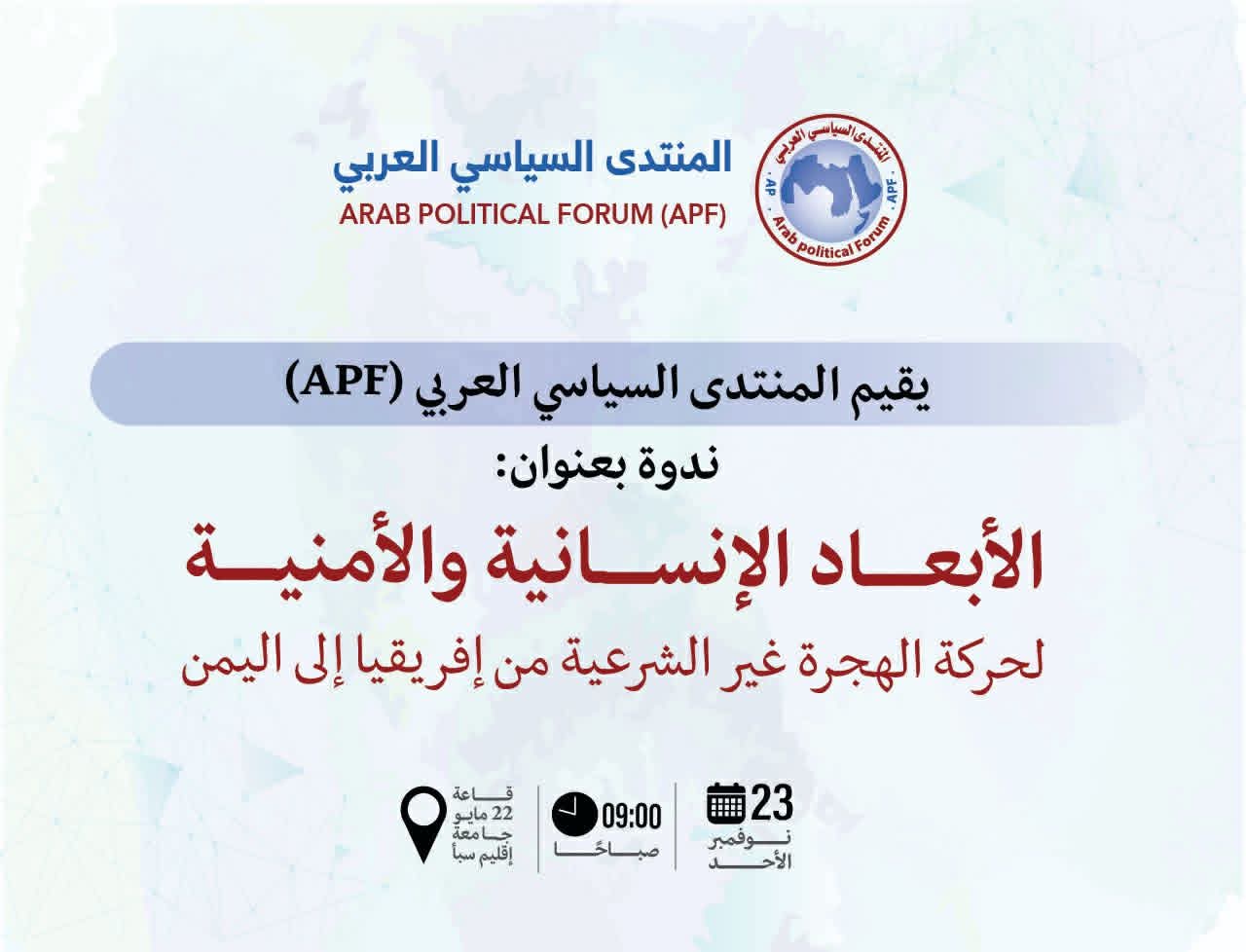
The Arab Political Forum (APF) organized a seminar titled “The Humanitarian and Security Dimensions of Irregular Migration from Africa to Yemen,” with the participation of a group of academics, researchers, and security officials.
The seminar highlighted the growing challenges posed by irregular migration from the Horn of Africa to Yemen, emphasizing that the country has increasingly become a forced destination of settlement for hundreds of thousands of migrants. This situation has exacerbated humanitarian, security, and economic burdens amid the ongoing war and economic collapse.
Professor Mohammed Al-Shaleef, who holds a Master’s degree in Public Law and serves as a lecturer in the Department of Law at Saba Region University, presented the first panel, which focused on “The Legal and Humanitarian Frameworks of Irregular Migration to Yemen.”
Professor Al-Shaleef emphasized that Yemen, despite its exceptional circumstances, remains obligated to uphold the principles of international humanitarian law and refugee law, particularly regarding the principle of non-refoulement and the protection of vulnerable groups.
He pointed out that a key challenge lies in distinguishing between economic migrants and asylum seekers, stressing the importance of providing humanitarian protection to migrants who fall victim to human trafficking and smuggling networks.
He also called for the activation of relevant national laws related to irregular migration and for strengthening coordination with international organizations to ensure adequate legal and humanitarian assistance.
The second panel was presented by Aiban Al-Hamali, a political researcher, under the title “The Economic Impacts of Irregular Migration on Yemen and the Role of International Organizations.”
Al-Hamali explained that the massive influx of migrants places significant and compounded pressure on already collapsing public services, particularly in the sectors of healthcare, water, and shelter, thereby increasing the suffering of Yemeni citizens.
He also noted that migration contributes to the spread of informal labor, which negatively affects employment opportunities for Yemeni youth and increases rates of unemployment and poverty.
Al-Hamali criticized what he described as the ineffective role of international organizations, noting that their focus on direct humanitarian relief fails to address the economic roots of the problem or alleviate the burden on the government and local authorities.
Brigadier General Najeeb Al-Nasser, Assistant Director General of Marib Governorate Police for Police Affairs, highlighted “The Security Dimensions of the Flow of Irregular African Migrants into Yemen.”
Al-Nasser emphasized that Yemen’s vast and fragile borders have become a central transit point for illicit smuggling operations, including human trafficking, arms smuggling, and drug trafficking, which undermines the country’s national security.
He explained that irregular migration is closely linked to organized crime and human trafficking networks, where migrants are subjected to exploitation and extortion. In many cases, they are used as fuel for conflicts or recruited into illicit activities by the Houthi group.
He called for strengthening the capabilities of security agencies and the coast guard in liberated areas and for establishing regional and international coordination to combat smuggling networks.
Dr. Khaled Al-Shajni, Deputy Director of the Executive Unit in Marib Governorate, presented the final panel titled “The Role of the Yemeni Government and Local Authorities in Addressing Irregular Migration.”
Dr. Al-Shajni noted that the government and local authorities are operating with extremely limited resources to provide temporary shelter and healthcare services for migrants, stressing that the response requires much greater international support commensurate with the scale of the influx.
He emphasized the need to develop a comprehensive national strategy for managing the migration file, including mechanisms for security monitoring, regulating the reception of arrivals, and providing options for safe voluntary return in cooperation with international organizations.
He also highlighted the importance of joint coordination with the countries of the Horn of Africa and neighboring states in order to curb migration flows and address their root causes in the countries of origin.
The seminar witnessed significant engagement from attendees, whose interventions focused on regional and international responsibility, the role of media and society, and the need for structural solutions to this phenomenon.



Post Comment