





The Conflict in The Region and Iranian Regime Disintegration Prospects: The Houthi Position and The Implications for Yemen
Share the post "The Conflict in The Region and Iranian Regime Disintegration Prospects: The Houthi Position and The Implications for Yemen"
Introduction:
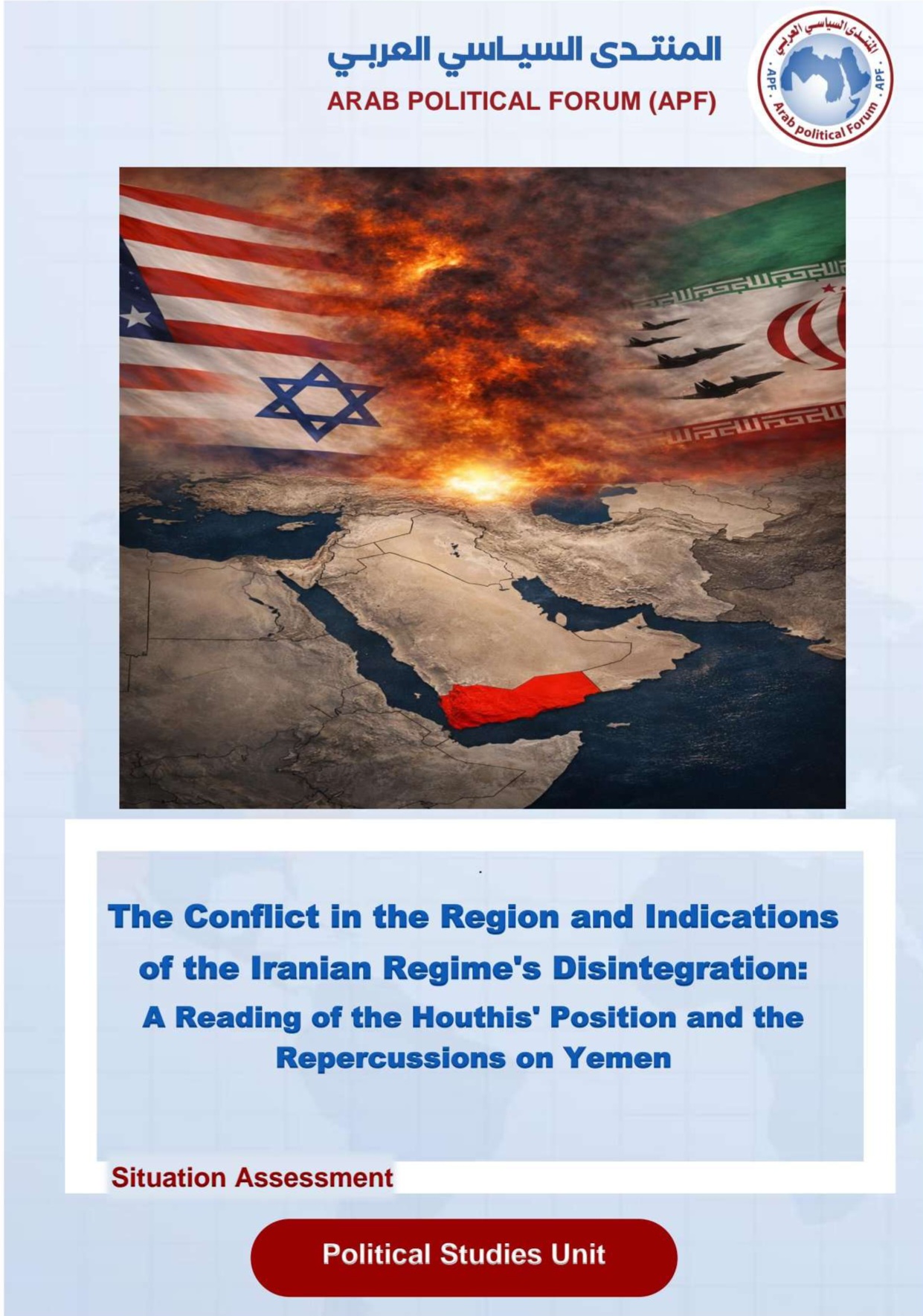
On February 28, the United States and Israel launched a military operation against the Islamic Republic of Iran, involving airstrikes by fighter jets, missiles, and bunker-busting bombs. The operation targeted the leadership hierarchy of the Iranian regime. It was carried out with the objective of dismantling the structure of the Iranian system built upon revolutionary ideology and the central authority of the Supreme Leader, and transferring the administration of the country to a negotiable elite willing to engage with Washington, as confirmed by U.S. President Donald Trump.
In contrast, Ansar Allah (the Houthis) did not announce their involvement in the ongoing conflict and have, thus far, adopted a position aimed at avoiding its potential repercussions.
This paper examines the details of the U.S.–Israeli military operation against Iran and its consequences, the emerging signs of the fragmentation of the Iranian regime, and provides an analysis of the Houthi position toward the conflict and its implications. It also explores the repercussions of this conflict on the Yemeni file and its balance of power, and finally presents a set of possible scenarios for the expansion of the conflict, the Houthi stance, and the evolution of the Yemeni file during the coming period.
Iranian Regime Fragmentation Signs:
At dawn on February 28, the United States and Israel launched a large-scale military operation against Iran that went beyond the conventional objective of destroying infrastructure or military capabilities. Instead, it directly targeted the leadership center of gravity and the supreme command structure of the Islamic Republic, with the aim of dismantling the Iranian regime.
The operation began with an intensive cyber offensive focused on disabling military communication networks and critical radar systems in western and central Iran, resulting in an effective electronic blackout. This cyber paralysis paved the way for squadrons of advanced stealth fighter jets, which successfully penetrated Iranian airspace without effective detection, taking advantage of their stealth capabilities and their ability to evade air defense systems.
This occurred in parallel with precision missile strikes using Tomahawk cruise missiles, launched from Arleigh Burke-class U.S. destroyers stationed in the Arabian Sea, in addition to laser-guided bunker-buster bombs used to target fortified command headquarters with extreme precision.
This hybrid tactic produced decisive results beyond expectations within a short period of time. Among the casualties was Iran’s Supreme Leader Ali Khamenei, who represented both the political and religious leadership of the country. Also killed were the Commander-in-Chief of the Islamic Revolutionary Guard Corps, Mohammad Pakpour, the Minister of Defense Aziz Nasirzadeh, the Chief of the General Staff Abdolrahim Mousavi, the Supreme Leader’s senior advisor Ali Shamkhani, and prominent members of the National Security Council, in addition to other first-tier leadership figures.
These precise strikes created a vacuum at the leadership level and within decision-making centers in the structure of the Iranian regime, rendering it more erratic in dealing with developments and making appropriate decisions due to the absence of a central leadership responsible for wartime decision-making.
This absence has produced early signs of the fragmentation of the Iranian regime and a transformation in the governing framework, in favor of the reformist current within the country. This shift involves transferring exclusive authority over the administration of the country to the elected president, Masoud Pezeshkian, and abolishing the position of the Supreme Leader after 47 years of religious authority parallel to elected institutions.
These signs began to materialize with the announcement—one day after Khamenei’s death—of the formation of a leadership council to manage the country’s affairs under the presidency of Pezeshkian. This development aligns with the U.S. plan to dismantle the regime in favor of a pragmatic reformist elite that is less confrontational toward Washington and more rational in negotiations, as confirmed by President Trump.
A structural transformation within the Iranian regime will inevitably lead to adjustments in the country’s foreign policy and the redefinition of its alliances in ways that reduce the costs of confrontation with former adversaries. It will also encourage greater inward focus domestically, limiting its external interventions through the support of non-state actors that have proven ineffective in protecting the regime, including Ansar Allah (the Houthis) group.
َ
The Houthi Position:
There exists a close relationship between the Iranian regime and Ansar Allah (the Houthis) that is reflected in the group’s conduct and decisions. Over the past years, the group has aligned its cross-border interventions with Iranian regional policies, whether by targeting the interests of Saudi Arabia and the United Arab Emirates, or by engaging in the conflict with Israel in support of Hamas and Lebanon’s Hezbollah under what has been referred to as the “Unity of Fronts.”
The Houthis’ alignment with Iranian preferences is understandable when examining its causes. The group has relied on Tehran’s support since its early stages and was able to seize power and build its military capabilities on the basis of that support.
Furthermore, being part of the “Axis of Resistance” led by Iran imposes commitments to the strategic orientation of that axis. This is in addition to their ideological connection to the symbolic authority of the Supreme Leader and their inspiration from the experience of the Islamic Revolution in Iran.
With the eruption of the recent conflict following the U.S.–Israeli attacks on Iran, the group displayed an unprecedented position that contradicted many expectations.
Hours after the attacks, Abdul-Malik al-Houthi, the leader of the group, delivered a speech stating that his movement was ready to support Iran and that Iran’s right to defend itself was legitimate. He argued that the Islamic Revolutionary Guard Corps and the Iranian army possess sufficient military capabilities to confront the aggression.
However, he did not disclose any real intention to enter the war or announce any procedural steps toward doing so—unlike previous occasions. Instead, he limited his response to offering condolences and calling for public and media mobilization.
The Houthi position appears below their usual level of engagement and seems—this time—more cautious in undertaking risks. This reflects a relative structural shift in the group’s thinking compared with the previous two years, which may be described as the “zenith of Houthi militancy.”
The change in the group’s current stance is further confirmed by its disregard for the symbolic significance of the killing of the Supreme Leader. The group did not declare mourning in areas under its control, unlike its reaction to the deaths of Iranian President Ebrahim Raisi and Hassan Nasrallah, the leader of Hezbollah, when it declared several days of mourning for each of them.
Although both figures held a significantly lower status than the Supreme Leader who was recently killed, the difference relates to the new timing and the cautious approach the group has begun to adopt.
The group has also lost its appetite for entering a new conflict after failing to achieve gains from previous attacks that resulted in significant damage to its position, including its designation as a Foreign Terrorist Organization (FTO) by the U.S. Treasury last year, the intensification of the blockade against it, and the targeting of many of its leaders and material capabilities.
In addition, it remains wary of the fate of Hezbollah in Lebanon, the Assad regime in Syria, and Iranian leadership figures who have been falling in rapid succession.
The crisis facing the Iranian regime prompted Hezbollah to enter the conflict in support of Iran by launching several missile attacks on northern Israel on March 2, prompting a violent response from the Israeli military. Exchanges of attacks between the two sides continue, yet the Houthis have maintained a more balanced position and are attempting to avoid direct involvement in the conflict.
Nevertheless, the caution displayed by the group remains limited. It may participate in the conflict at limited levels and then gradually escalate, particularly if the conflict—most likely—extends for several weeks and the Iranian regime manages to maintain cohesion and restore confidence.
In the highest conceivable escalation scenario, the Bab al-Mandab Strait could emerge as a potential target for attacks launched by the group from Yemen. However, such actions would not succeed in pressuring Washington to halt its campaign aimed at bringing about the fall of the Islamic revolutionary system.
It has become evident that Yemen has not been capable of exerting decisive influence on the events and destiny of the region. Rather, its role has been limited to causing “restricted disruption.” Yemen therefore appears more likely to be affected by developments in the coming period than to influence them.
َ
Features of the Yemeni File:
On the opposing side of the map of influence in Yemen stands the Presidential Leadership Council (PLC), representing the Yemeni government recognized internationally, in opposition to the Houthis. Although it has not intervened in the ongoing conflict in the region, it does not conceal its interest in it, given the conflict’s centrality in reshaping regional influence and the implications this carries for the countries of the region, including Yemen. The Council issued an official statement condemning the Iranian attacks on the Gulf states and warning the Houthis against becoming involved in the conflict in order to protect the Iranian regime—according to its description.
Over the past years, Yemen has been affected by the fluctuations that have swept the region and the world, beginning with the military campaign of the Arab Coalition with its diverse parties, followed by successive changes in the administration of the White House, then the Saudi–Iranian agreement brokered by China, and finally the “October 7 Operation” and its repercussions.
Experts argue that the Yemeni file has been subject to an approach of “internationalization,” or what may be described as “regionalization,” since the Houthis seized power. Accordingly, any changes that occurred in the Yemeni file were largely a response to the regional and international environment. From this perspective, the Council is counting on the recent conflict to capitalize on it in a way that redefines the balance of power in its favor in confronting the Houthis, and it is seeking to leverage this opportunity in whatever way possible.
The disintegration of the Iranian regime’s structure—built upon revolutionary ideology—in favor of a new pragmatic elite focused inward domestically would constitute a shock to the Houthis. It would push them to shift toward a defensive posture and focus on the risks to their survival rather than pursuing offensive expansion and attempts to broaden their influence.
Since the establishment of the Islamic Revolution in Iran, the regime has adopted the doctrine of “exporting the revolution” and remained open to supporting non-state allies, which it considered its “forward defense armies.” This approach provided the environment in which the Houthis emerged and were able to develop their capabilities.
With the end of this outward-oriented Iranian approach, the Yemeni government would be in a better position, as its local adversary would become more isolated and more limited in terms of external support.
Although the Houthis have achieved a relatively notable degree of success in diversifying their sources of support and building a rudimentary network of alliances—whether in the Horn of Africa or through limited relations with Moscow and Beijing—none of this would compensate for the vacuum that the potential disintegration of the Iranian regime would leave behind.
During the coming period, the balance of power in Yemen is likely to shift in favor of the government in a manner that does not serve the Houthi movement. At a minimum, this would weaken its presence and, at the highest potential threshold, threaten its very existence—particularly if Riyadh supports a large-scale military operation against it.
In such a case, the Houthis’ only option to preserve their survival would be to threaten Saudi interests using the missiles and drones in their possession. However, this would represent their final card.
Possible Scenarios:
Scenario One: Cautious Engagement
This scenario assumes that the Houthis would participate in the ongoing conflict in a limited manner as a form of commitment toward the Iranian regime. Their attacks would primarily focus on Israel, without engaging in a broader conflict—particularly with the Gulf states, foremost among them Saudi Arabia.
Such involvement would likely prompt Israel to target the group with airstrikes by its fighter jets at a moderate initial pace, postponing the objective of eliminating its capabilities until after it has completed its efforts to dismantle the Iranian regime and Hezbollah.
Under these circumstances, the ultimate decision regarding the complete elimination of the Houthis’ presence would be left to the strategic considerations of Riyadh at a later stage.
This scenario appears to be the most likely because it aligns with the will currently expressed by the Houthis and is based on their agency as the principal decision-making actor. However, they may—against their own intentions—slide into the scenario of open engagement, particularly if Saudi Arabia becomes involved after being subjected to attacks, as the dynamics of the ongoing conflict cannot be controlled by a single party.
Scenario Two: Open Engagement
This scenario envisions a broader Houthi intervention in the conflict in support of the Iranian regime. In response, they would be subjected to U.S. and Israeli strikes, which would in turn lead to the involvement of Saudi Arabia at the forefront of the conflict after its territory comes under attack from forces aligned with Iran, including potential strikes on its oil facilities.
This would effectively mean the collapse of the fragile truce and would likely prompt Riyadh, in the near term, to support the launch of a ground operation against the Houthis, at a time when the group would lack the effective Iranian support on which it previously relied—regardless of whether the Iranian regime ultimately collapses or manages to maintain its cohesion.
Scenario Three: Cautious Neutrality
This scenario would be the least costly for the Houthis if fully realized, which may encourage them to adopt it. It entails refraining from involvement in the ongoing conflict in order to preserve their capabilities for any potential internal confrontation, as well as to avoid a U.S. and Israeli response.
However, this scenario does not guarantee that the Houthis would avoid U.S. and Israeli strikes despite their belated neutrality. It is likely that they remain a deferred target for the administration of U.S. President Donald Trump and the Israeli government.
In this case, they may enjoy a temporary period of respite, but strikes against them would likely resume later with the objective of eliminating their military capabilities.
By Author:
Related